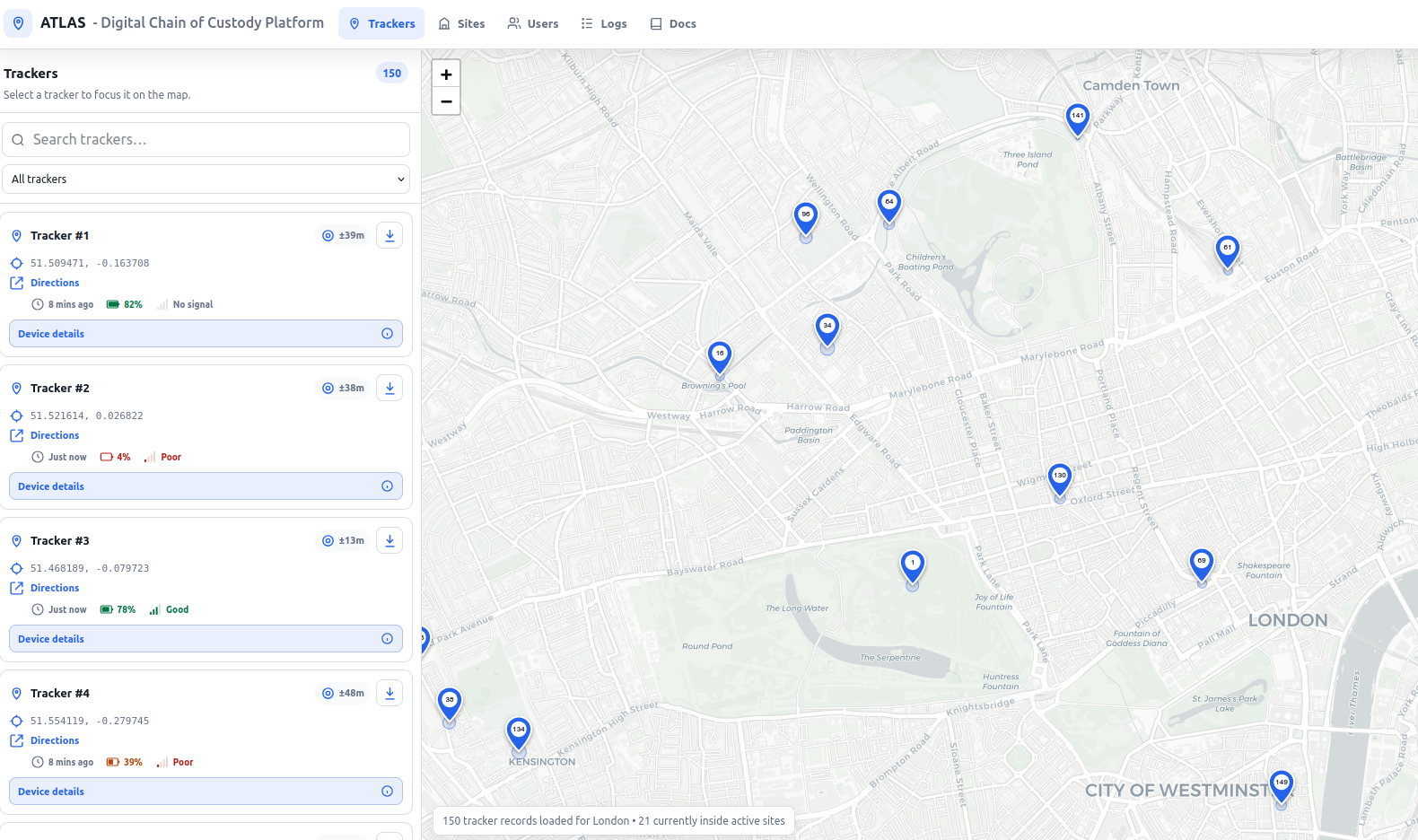
ATLAS and Tive Solo 5G both combine location information with environmental context. The useful buying question is which hardware, connectivity and software package fits your operation. This comparison focuses on practical requirements rather than assuming that one tracker is best for every deployment.
Published by T2K Group, the team behind ATLAS. Competitor details are drawn from the linked manufacturer documentation reviewed on 12 October 2026. ATLAS details reflect our supplied specification and testing; this is not an independent head-to-head test.
ATLAS and Tive Solo 5G at a glance
| Requirement | ATLAS | Tive Solo 5G |
|---|---|---|
| Positioning | GPS, Wi-Fi and multi-cell positioning. | GPS, Wi-Fi and cell-tower triangulation. [1] |
| Connectivity | Multi-network SIM included. | LTE-M with 2G fallback; Tive advertises coverage across 400+ networks. [1] |
| Environmental and device sensing | Temperature, humidity and orientation detection. | Temperature, humidity, shock, light and motion. [1] |
| Battery reference | Up to one month in ATLAS testing with one-hour reporting intervals and good outdoor coverage. | Manufacturer claims: non-lithium version 30+ days at hourly transmission; lithium-ion version 50+ days at hourly transmission. [1] |
| Reporting schedules | Configurable reporting intervals. | Programmable measurement intervals; distinguish these from transmission schedules. [1] |
| Reports and exports | Monitoring, retained history and exports. | Shipment report exports in PDF and CSV. [2] |
| Team access | User accounts and permissions. | Configurable role permissions; custom role creation requires Plus or Premium. [3] |
Hardware, positioning and sensor requirements
ATLAS uses a 60 × 60 × 20 mm package. Check available space, mounting and access for servicing before selecting either device. Tive’s published sensor mix includes light and shock, while the ATLAS specification includes orientation detection. These are different signals: ask for a demonstration of the event you need rather than treating motion, shock and orientation as interchangeable.
Indoor performance needs a deployment check. GPS, Wi-Fi and cell-based location can provide different levels of precision, and a reported position should always be read alongside its timestamp and available accuracy information.
Compare battery life at the reporting schedule you need
A longer reporting interval gives the team fewer routine location updates. Choose the data frequency needed for your operation before comparing endurance. Ask both suppliers to distinguish sensor sampling, location fixes and data uploads, and assess reception in the actual mounting position. Manufacturer estimates and ATLAS testing were not conducted under a common protocol.
Monitoring, exports and team access
For software evaluation, request the same demonstration from both suppliers: find a device, inspect its historical location, review a sensor event, export a chosen date range and restrict a user’s access. Tive’s reporting and user-management documentation confirms that exports and permissions are shared capabilities, so the comparison should focus on the workflow and subscription tier. [2] [3]
Also compare data retention, export fields, user limits, support and subscription costs. A device specification alone does not establish which features are included in the service you purchase.
Devices support the wider custody process
ATLAS devices are one part of a wider digital chain of custody. Reported locations, timestamps and device events support review, but do not prove who held an asset, verify a handover or confirm a container’s contents. Keep separate possession records, transfer sign-offs and physical checks.
Read how device location history supports digital chain of custody.
Which package fits your operation?
ATLAS is worth evaluating when you need compact devices, included multi-network connectivity and shared oversight of critical assets, including election operations. Tive is worth evaluating when your requirements centre on shipment monitoring and its documented sensor and reporting features. That assessment is based on the published feature sets, not a head-to-head field trial.
Use a short pilot to check mounting, reporting frequency, connectivity, sensor interpretation and the work needed to prepare an export. Compare written quotes for the same device count, duration, reporting schedule and support requirement before drawing a cost conclusion.
Sources and specification notes
ATLAS specifications: 60 × 60 × 20 mm, included multi-network SIM, GPS/Wi-Fi/multi-cell positioning, temperature, humidity and orientation detection, configurable intervals, monitoring, exports and user permissions. Battery reference: ATLAS hourly-reporting test with good outdoor coverage. Confirm the current configuration and service package with each supplier.