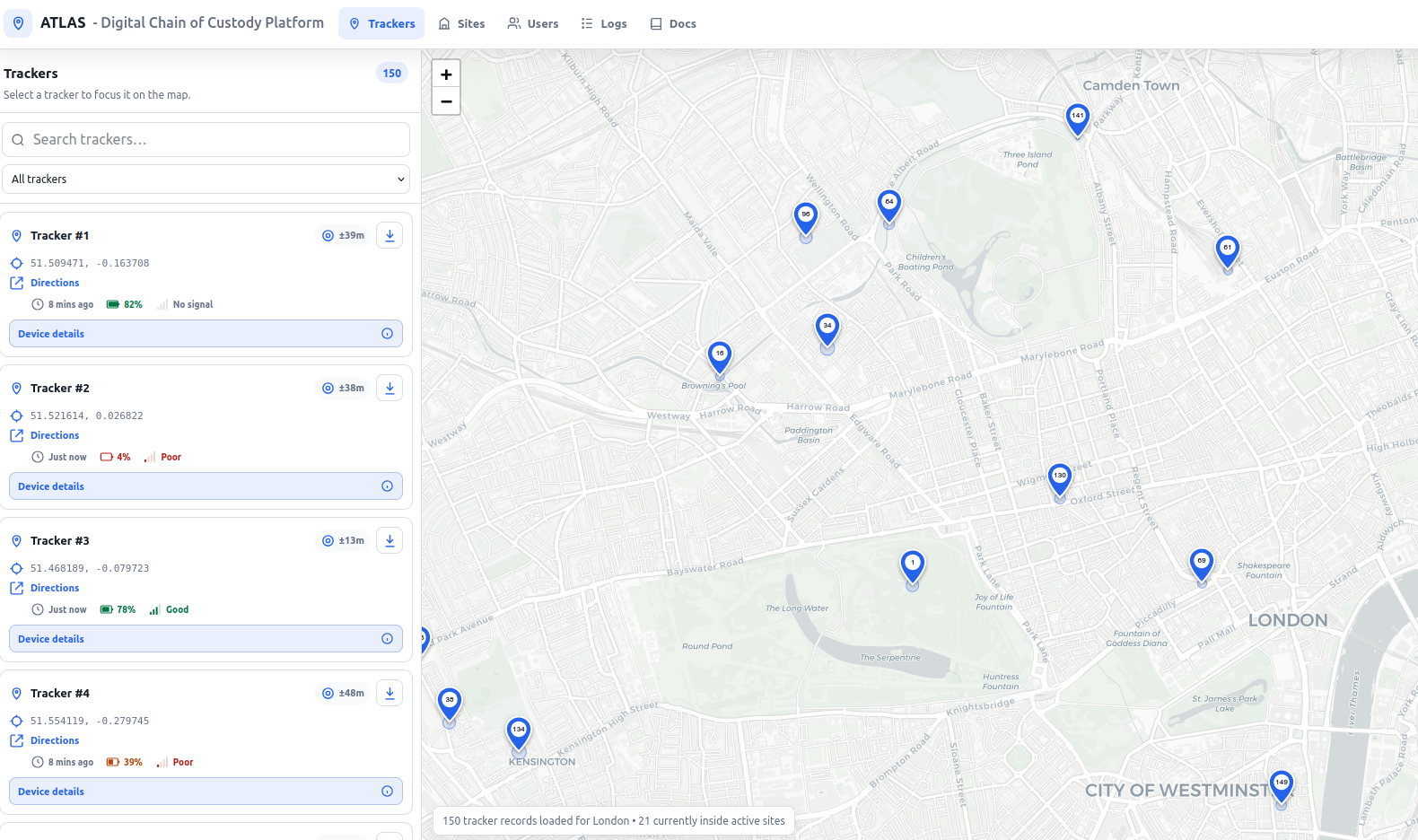
ATLAS and Roambee BeeSense Flex are relevant options when the location of an asset and the conditions around it both matter. Their overlapping capabilities make size, required sensor events and the complete service package useful starting points for an evaluation.
Published by T2K Group, the team behind ATLAS. Competitor details are drawn from the linked manufacturer documentation reviewed on 12 October 2026. ATLAS details reflect our supplied specification and testing; this is not an independent head-to-head test.
ATLAS and Roambee BeeSense Flex at a glance
| Requirement | ATLAS | Roambee BeeSense Flex |
|---|---|---|
| Dimensions | 60 × 60 × 20 mm. | 116 × 69 × 22 mm. [1] |
| Positioning | GPS, Wi-Fi and multi-cell positioning. | GNSS and Wi-Fi location, with cellular connectivity. [1] |
| Connectivity | Multi-network SIM included. | 4G LTE Cat 1 and GSM; the datasheet lists global cellular coverage and a nano-SIM interface. Confirm the supplied roaming package. [1] |
| Environmental and device sensing | Temperature, humidity and orientation detection. | Temperature, humidity, motion, light and shock; also supports BLE scanning. [1] |
| Battery reference | Up to one month in ATLAS testing with one-hour reporting intervals and good outdoor coverage. | Manufacturer claim: 15–40 days per charge, depending on cloud reporting interval. [1] |
| Reporting schedules | Configurable reporting intervals. | Wake-up schedule adjustable from six minutes to 24 hours, with excursion-triggered wake-up. [1] |
| Software package | Monitoring, exports, user accounts and permissions. | The datasheet describes uploads to Roambee HC Cloud. Confirm export formats and account permissions for the quoted service. [1] |
Hardware, positioning and sensor requirements
The published dimensions make ATLAS the smaller device in this comparison. That can matter when fitting a tracker into an existing container or equipment case, but mounting and reception still need testing. BeeSense Flex offers a broader documented sensor mix, including light and shock. Decide whether you need orientation detection, impact information, environmental readings or a combination, then check how each signal appears in the platform.
Indoor performance needs a deployment check. GPS, Wi-Fi and cell-based location can provide different levels of precision, and a reported position should always be read alongside its timestamp and available accuracy information.
Compare battery life at the reporting schedule you need
A longer reporting interval gives the team fewer routine location updates. Choose the data frequency needed for your operation before comparing endurance. Ask both suppliers to distinguish sensor sampling, location fixes and data uploads, and assess reception in the actual mounting position. Manufacturer estimates and ATLAS testing were not conducted under a common protocol.
Monitoring, exports and team access
ATLAS provides monitoring, exports and user permissions as part of its platform. For BeeSense Flex, the hardware datasheet establishes the cloud connection but is not enough to assess the complete software offer. Ask Roambee to demonstrate historical records, event review, exports and access controls for the service being quoted. An undocumented detail here is a question to verify, not evidence that the competitor lacks it.
Also compare data retention, export fields, user limits, support and subscription costs. A device specification alone does not establish which features are included in the service you purchase.
Devices support the wider custody process
ATLAS devices are one part of a wider digital chain of custody. Reported locations, timestamps and device events support review, but do not prove who held an asset, verify a handover or confirm a container’s contents. Keep separate possession records, transfer sign-offs and physical checks.
Read how device location history supports digital chain of custody.
Which package fits your operation?
ATLAS is worth evaluating where space is limited and the team needs location and environmental context around critical assets. BeeSense Flex is worth evaluating when its shipment sensor mix or BLE scanning is important. Those are feature-based evaluation starting points; neither establishes better accuracy or reliability without comparable deployment testing.
Use a short pilot to check mounting, reporting frequency, connectivity, sensor interpretation and the work needed to prepare an export. Compare written quotes for the same device count, duration, reporting schedule and support requirement before drawing a cost conclusion.
Sources and specification notes
ATLAS specifications: 60 × 60 × 20 mm, included multi-network SIM, GPS/Wi-Fi/multi-cell positioning, temperature, humidity and orientation detection, configurable intervals, monitoring, exports and user permissions. Battery reference: ATLAS hourly-reporting test with good outdoor coverage. Confirm the current configuration and service package with each supplier.